Case study · 2 ASINs
Desk paper tray sales up 51% while searches fell 28%
Product journey. 2 desk paper trays, 1 brand. 9 Oct to 5 Nov 2026, against the 4 weeks before.
- Monthly sales
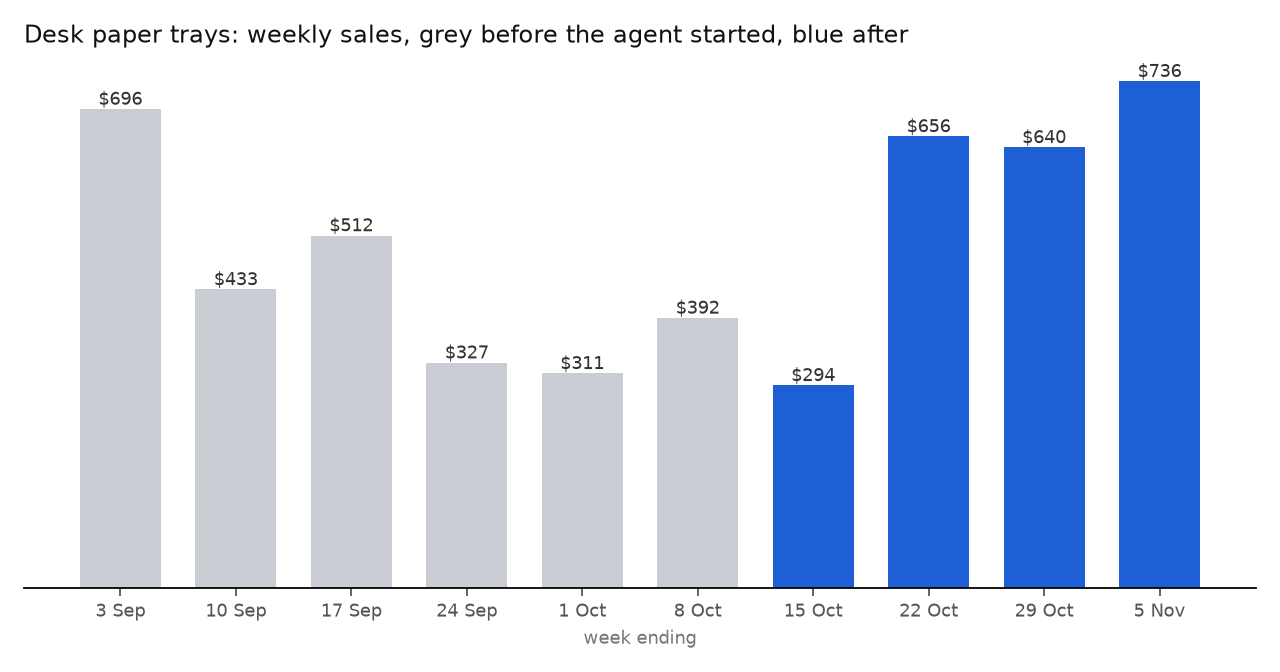
- $1,650 $2,490 +51%
- What the agent did
- 43 changes: Ads 24 · Listing 14 · Price 5
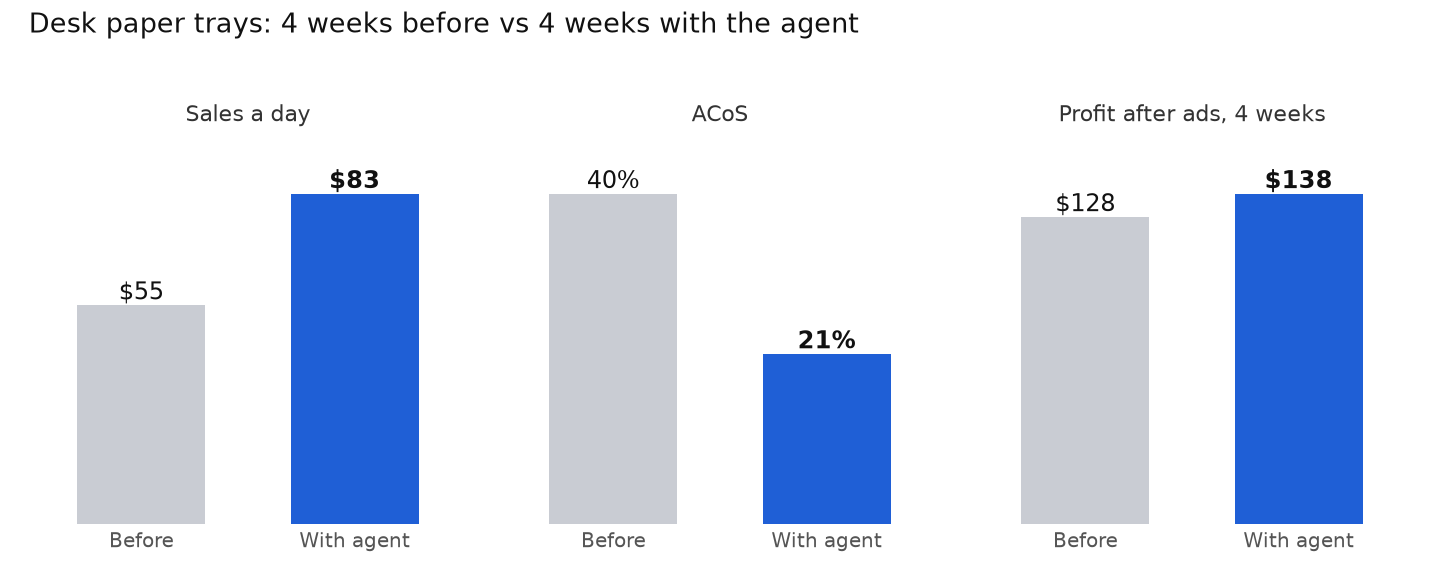
A seller of metal desk paper trays was making $55 a day on 2 trays. Over the 4 weeks the growth agent ran them, that went to $83 a day, and $98 a day in the last 2 weeks. Searches for these trays fell 28% over the same weeks. ACoS went from 40% to 21%, on about $4 a day of ads, and the 11x17 tray made $131 more profit than in the 4 weeks before.
Superfuel runs a growth agent on Amazon brands' ads, prices, listings and images, and logs every change with why, what it expects and when it checks. Here's everything it did on these 2 trays, how it checked its own work, and what it's doing next.
The 2 trays
One is a 2-tier metal tray that holds 11x17 paper flat, at about $40. Each sale leaves about $8 after Amazon's fees and the unit cost. The other is a 3-tier tray for legal-size paper, at about $18, which leaves $2.83 a sale.
That gap shaped what the agent did on each. The 11x17 tray can afford about $0.88 a click before the ad loses money. The legal-size tray can afford about $0.11. Same seller, and one tray can afford 8 times more per click than the other.
Before the agent started, the 11x17 tray had almost no ads behind it: $2.30 of ad spend in 4 weeks. Its sales had fallen from $1,494 in one 4-week stretch to $610 in the next, as its sessions halved. The legal-size tray's ads ran at 42% ACoS, almost all through 2 automatic campaigns.
The agent made 43 changes on 12 different days: 24 on ads, 14 on the listings and 5 on price.
Week 1: lead each title with its size, then advertise on those searches
9 Oct, listing. It rewrote both titles, bullets, descriptions and backend search terms. On the 11x17 tray, it moved "11x17 Paper Tray Organizer" to the front of the title and the brand name to the end, since the brand had no search volume. On the legal-size tray, it led with "Legal Size", since only about 2 of 30 search results were legal-size desk trays. The bullets answered the top complaints in rival reviews: wobbling, flimsy build and confusing assembly.
10 Oct, ads. It gave the 11x17 tray its own exact campaign, $10 a day, on the searches that name its size, like "11x17 paper tray" and "11x17 paper organizer". Why: the tray already had a top organic rank on "11x17 paper tray", so shoppers on that search were already buying it. The upside: winning back the sessions and sales it had lost, about $880 a month, since its sales had fallen from $1,494 to $610 over 4 weeks as its sessions halved. Each order leaves about $8. The bid started well under what a click on this tray can afford. In 30 days it took 45 clicks and 3 orders at 16% ACoS.
13 Oct, ads: checked its own new campaign. "11x17 paper organizer" hadn't been shown once, while the campaign's other searches got clicks. So the bid was what held it back. The upside: a search that names the tray, with a search volume of about 1,000 a month, where it already had organic rank 10. It raised that bid. In the next 14 days that search took 12 clicks and 1 order at 18% ACoS.
Week 2: small tests where the economics work
21 Oct, ads. The legal-size tray can't pay for broad searches like "desk paper organizer", which cost $0.34 to $0.40 a click. So the agent looked at where the tray already sold: organic rank 6 on "legal paper tray" and 9 on "legal size paper tray", and 1 order on 4 clicks at 9% ACoS through an older campaign. The upside: the tray's sales had halved over 4 weeks, from $1,242 to $619, as its sessions fell 25%, and these 2 searches have a search volume of about 800 to 1,300 a month between them. So it ran 1 small test on those searches, $5 a day. It made 2 orders for $3.20 of ads, 6% ACoS.
22 Oct, ads. With about $8 left per order, the 11x17 tray could pay for more reach. So it added a $5-a-day phrase campaign, so the ads reached the longer versions of its 2 main searches, each with a search volume of about 1,000 a month ("11x17 paper tray organizer for desk"). 2 orders, $4.70 of ads, 6% ACoS.
What it changed after checking the results
27 Oct, listing: checked its own first title. Moving "11x17 Paper Tray Organizer" to the front had worked: clicks on "11x17 paper organizer" went up 88%. But the first rewrite had dropped the word "storage", and on "11x17 paper storage", with a search volume of about 365 a month, clicks fell 47%. The second rewrite kept the new front of the title and put "storage" back.
Where the growth came from
All of it came from the 11x17 tray. Its sales went from $23 a day to $63. Its sessions went from 6.9 a day to 11.5, and its conversion rate went from 8.3% to 13.6%. 80% of its sales were organic, and its ads ran at 9.7% ACoS.
The legal-size tray fell 37%, from $32 a day to $20. Its conversion dropped from 9.2% to 7.2%, most likely because Amazon put a "Frequently returned" badge on it. Both returns were marked not as described: wrong size, too bulky.
What it plans next
Legal-size tray, ads. Keep its bids near what its clicks can pay, and block the general searches it can't afford. Its ads lost $52.67 in 4 weeks, about $56 a month.
Legal-size tray, price. Move to $18.99, so each sale keeps more.
Legal-size tray, images and listing. Redo the size image with the real outer dimensions and put the outer size in the first bullet, since size is what the returns say.
11x17 tray, ads. Raise bids on the searches that name its size and add "tabloid paper organizer", still under what a click on this tray can afford. Today it gets 2.4 ad clicks a day, too few to keep the growth going. It has 97 units, about 60 days of stock, so a restock before the Q4 peak matters too.
What works, what doesn't, and why
- Its own exact campaign on searches where a product already has a top organic rank works. The 11x17 tray went from $23 a day to $63, with 80% organic sales and ads at 9.7% ACoS, because shoppers on those searches were already choosing it.
- A thin margin limits what ads can do. The legal-size tray leaves $2.83 a sale, so a click can cost about $0.11, while broad searches cost $0.34 to $0.40. Its sales fell from $32 a day to $20, because most paid traffic costs more than it can earn back.
- Small capped tests on searches with an organic rank on page 1 pay. The legal-size test took 2 orders for $3.20 of ads, 6% ACoS, because the tray already sold there.
- Keep the words in the title that bring clicks. Dropping "storage" cut clicks on "11x17 paper storage" by 47%, because shoppers search for that word.
- Size complaints in returns cost conversion rate. The legal-size tray went from 9.2% to 7.2% after a "Frequently returned" badge, and both returns said wrong size.
What does a click cost you, and what can each of your products afford to pay?