Case study · 6 ASINs
Wooden crate sales went from $324 to $446 a day while the best seller was out of stock
Product journey. 6 wooden crate sets, 1 brand. 9 Oct to 5 Nov 2026, against the 2 weeks before.
- Monthly sales
- $9,720 $13,380 +38%
- What the agent did
- 97 changes: Ads 24 · Listing 24 · Images 45 · Price 4
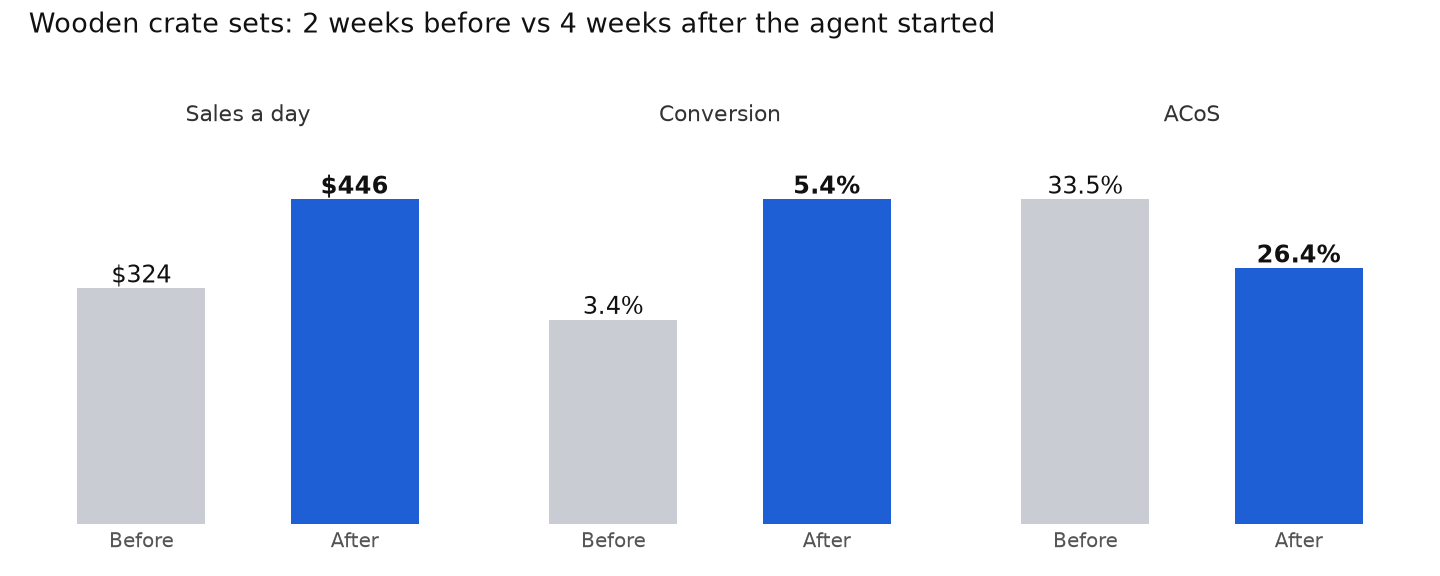
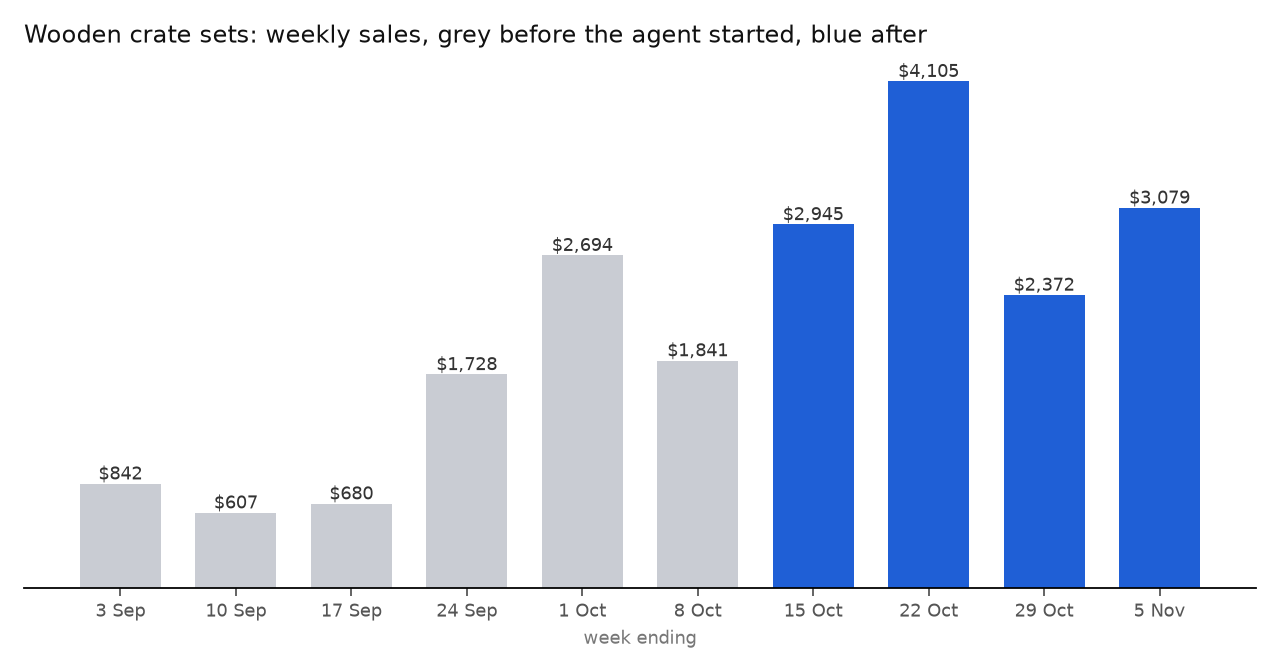
In the 2 weeks before a growth agent took over a seller's wooden crate sets, they sold $324 a day. Over the 4 weeks since, they've sold $446 a day. For most of that time the best-selling set was out of stock. The other 5 sets went from $136 a day to $363. The line's loss after ads shrank from $302 to $193 over 4 weeks, and the first 5 days of November made a profit.
Superfuel runs a growth agent on Amazon brands' ads, prices, listings and images, and logs every change with why, what it expects and when it checks. This is everything it did on one product line in its first 4 weeks: the moves, how it checked its own work, and what it plans next.
Where it started
Each set is 4 nesting wooden crates, sold in 6 colours at about $40 a set. In the 2 weeks before the start, ACoS was 33.5%, and the conversion rate was only 3.4%.
The ads had 3 problems. 66% to 95% of the crates' ad spend sat in campaigns shared with hundreds of other products, so no bid was aimed at the crates. 2 of the 6 sets, natural brown and distressed white, had no ads at all. And the light honey set, which made 58% of sales, was running out of stock.
Over the next 4 weeks the agent made 97 changes on 14 different days: 24 to ads, 24 to titles, bullets and backend search terms, 45 to images and 4 to prices.
Week 1: own ads for the crates, and titles that match the search
9 Oct, ads. It gave the crates their own exact-match campaign, so their bids were no longer set by a campaign built for hundreds of other products. It put in only the sets that were in stock and already selling, and left the light honey set out because it had no stock. The upside: the crates' best searches already sold, "wooden crates" at 27% ACoS and "wooden crate" at 17%, and now their bids were set for the crates alone. In 30 days the campaign took 114 orders and $5,771 of ad sales on $1,715 of ads.
12 Oct, listing. It rewrote the titles on all 6 sets to say "wooden crates", with a search volume of about 103,000 a month. None of the sets ranked for it. To make room, it moved the brand name out, because almost nobody searched for the brand. The bullets now open with the exact size of each crate, since size was the top complaint in rival sets' reviews. One bullet says plainly that the wood is thin and suits storage and display, not heavy loads, because that was the top complaint in the seller's own reviews.
14 Oct, ads. It added the natural brown set to the campaign. It had $1,354 of organic sales in 30 days, and a 6.7% conversion rate, the best of the 6. The upside: the best-converting set on searches that already sold, with no new bid. In the 30 days after, it sold $2,512, 30 of those orders from ads.
Week 2: images, budget and placements
17 and 21 Oct, ads. The campaign ran out of its $25 budget on 5 of its first 8 days while it was selling, so the agent raised the budget to $50, then $70. The upside: a campaign that had sold $1,065 in 8 days on $327 of ads could run all day; on the days it had more budget, it took about 97 clicks instead of 45. After the first raise it took 5.6 orders a day.
19 to 21 Oct, images. New 9-image sets for all 6 colours. Each one answers a review complaint: each crate's size labelled, a solid bottom with cans sitting flat, the wood sanded smooth with no splinters, lifting it by the cutout handles. The upside: the conversion rate was only 3.4% before. Across the line it went to 5.4%, with titles and ads changing in the same weeks, and on the espresso set it went from 0.3% to 0.9%.
21 Oct, ads. On an older campaign for the antique brown set, it removed the 35% top-of-search placement bid adjustment, because that's where the campaign sold worst: 268 clicks for 2 orders, about 138% ACoS. On product pages the same campaign sold 11 orders on 219 clicks. The upside: it stopped paying the adjustment on the placement where $221 had bought 2 orders since 9 Sep.
Weeks 3 and 4: working around the stock-out
The light honey set was out of stock or nearly out from 3 to 30 Oct, and lost its Amazon's Choice badge. By 26 Oct, 4 of the 6 sets were short on stock too.
2 Nov, ads. The light honey set came back in stock, so the agent put it back in the campaign. It added no budget: the set now shares the campaign's spend with the others. The upside: before it ran out it sold 3 to 5 sets a day, about $120 to $200 a day at about $40 a set. In the 4 days after, the campaign took 14 orders.
What it changed after checking the results
12 to 15 Oct, ads. On 12 Oct it raised the bid on "wooden crate", because it was getting no clicks. When it checked the raise, it was mostly buying the same shoppers the "wooden crates" keyword already bought, at a higher price a click. So it brought the bid back down, and the 2 keywords stopped paying twice for the same shopper. "Wooden crate" then took 1.9 orders a day, up from 0.4.
The results
Over 9 Oct to 5 Nov, against the 2 weeks before, judged on the line as a whole, since titles, images and ads changed in the same 2 weeks:
- Sales went from $324 a day to $446.
- Conversion rate went to 5.4%, up from 3.4%.
- ACoS went from 33.5% to 26.4%, on fewer ad clicks: 116 a day, down from 147.
- The antique brown set went from $23 a day to $99. Distressed white went from $9 to $68. Natural brown went from $48 to $90.
- The light honey set fell from $188 a day to $84, because it was out of stock.
What it plans next
- A crate-only ACoS target of about 21%, not 45%. Lower bids and blocking the searches that keep spending with almost no orders, so the line stops losing money on ads.
- Restock before mid-November. The natural brown set has 16 days of stock and nothing on the way. That one is for the seller.
- Fix 2 bullets that call a stained set "raw wood".
What works, what doesn't, and why
- Advertising a variant with strong organic sales pays off. The natural brown set went from $48 a day to $90, because shoppers were already choosing it: its 6.7% conversion rate was the best of the 6.
- A product line's own campaign beats a shared one. It took 114 orders and $5,771 of ad sales on $1,715 of ads in 30 days, because the bids were set for the crates, not for hundreds of other products.
- Images that answer review complaints lift conversion rate. Across the line it went from 3.4% to 5.4%, with titles and ads changing in the same weeks, because the images showed the sizes and build shoppers had worried about.
- Ads can't sell stock that isn't there. The light honey set fell from $188 a day to $84 while out of stock, so ad spend went to the sets that still had it.
- A thin margin keeps ads in the red. At 26.4% ACoS against a break-even of 21% to 24%, the line still lost $193 after ads in 4 weeks, because a $40 set leaves little after fees and product cost.
What ACoS target are your bids set against, and is it right for every product line?